Wednesday, October 31, 2018

erased fiscal intersection by SPMI peer advocates in 2003 followed by autistic self advocates since 2007


  No more consumer-survivor rejection of prescription medications (and the medical model of disability) without cognizance and activism supporting Medicare for All as a universal buy-in additional health insurance choice to individuals, not a requirement to enroll,

and demanding an end to private insurer and taxpayer greed that cuts funding and doctor networks to improve individual mental health that improves long term outcomes if the individual receives LTSS, delivered in HCBS, after progressive public budgets overcome the austerity of the waiting list.


   Stephanie Mencimer took 8 years from 2003 until the publication of her 2011 Mother Jones article


 about Jared Loughner, killer of child Christina Green, born on Sept. 11, 2001, Federal Judge John Roll and wounded ex-AZCD8 (AZCD2 after 2012 election cycle redistricting seat held by R-Martha McSally 2014-18) Democratic member Gabrielle ‘Gabby’ Giffords among other victims, for Mencimer to make the connection to shifting money, from paying for institutions and their drugs and devices, prescribed by doctors financed by profit-greedy insurance companies managed 'one size fits all for efficiency' care. 


    For-profit and nonprofit private insurance companies, if they buy into the growing consensus that health care is a human right, must have their contracted benefits follow the person as payment for person-centered, community services instead of the consumer/survivor ‘community’ receiving some leadership of peer-run programs without the money following the person, including persons never institutionalized, from the institutional model to the community-based, person-centered model.   Human medical needs aren't a total production cost divided into unit costwidgets’ in b-school economics classes
as a way of developing social safety net (health and human, social services) budgets at all government levels.   The Judge David Bazelon Center throughout its history ignores the role of money except to close institutions not keep people who are out of them, but at risk of placement if they lose a job, housing or have another life transition, included in community. 


   Fuller Torrey in this 1998 Brain Storm article (reprinted from the Washington D.C. City Paper) called out managed care 'one size fits all for efficiency for profit' practice of medicine and even United Health Care CEO Bill McGuire’s $6.1 million 1 year  ($1 Billion in UHC CEO career) salary.


Over the course of two hours, Torrey rails against federal funding schemes for mental health care and attacks civil liberties lawyers for preventing sick people from getting well. He takes some potshots at John Mack, the Harvard psychiatrist who bills insurance companies for psychotherapy treatment for people who've been abducted by aliens. He skewers "mangled care" companies for paying CEOs multimillion-dollar salaries at the same time that they deprive the mentally ill of treatment. After noting that in 1994 William McGuire, CEO of United Healthcare, received $6.1 million in compensation, Torrey says, "If any of you think William McGuire is going to give back $1 million to open a clubhouse [a successful day program for the mentally ill], see me afterward and I'll give you a prescription for Haldol."


    Peer (consumer-survivor) advocates were fighting to end stigmatizing language in a 2003 article (The Sick and The Dead by Stephanie Mencimer) while safety net, publicly funded, inclusive, community-based services to one population (people with SPMI/mental illness and substance abuse disorders) were being devastated as similar services to another population (people with ID/DD formerly known as MR/mental retardation before 'Rosa's Law' rewrote federal laws) were cut to a lesser extent.  

    Peer consumer-survivor advocates erased (ignored) the fiscally intersectional questions of whether a person living with mental illness was receiving treatment or not

Untreated serious mental illness is a huge risk factor for violent crime, particularly among those released from mental hospitals. A 1992 study by Dr. Henry Steadman, now the chair of the national advisory board of the Center for Mental Health Services & Criminal Justice Research, found that 27 percent of released patients reported having engaged in at least one violent act within four months of being discharged. Those findings mirror older research suggesting that discharged patients had arrest rates for violent crimes 10 times that of the general population. Another study, published in the American Journal of Public Health in 2002, found that about 14 percent of adults with severe mental illness (schizophrenia and bipolar disorder) had been violent within the previous year. Not surprisingly, then, 16 percent of jail inmates are estimated to be mentally ill, according to the Justice Department—some 300,000 people, or four times the number who are in mental hospitals today in the United States. 


, and how to pay for adequate treatment if the individual could not, in their 2003 protest letters.   Autistic 'self-advocates' still ignore the same fiscally intersectional question 'who pays the costs' of 'autistic community' goals of inclusion and acceptance if individual autistics cannot pay the costs.  


  The MacArthur Foundation study, quoted by 2003 mental health advocates in their letters,


 may have also left out the distinction between treated and untreated, and implications for law and budget policy in assuring access to high quality, community based, treatment, in measuring the risk of person living with mental illness committing a violent crime. 


  The demands of one of the 2003 anti-stigmatizing language protest letters for more funding for better quality independent living services for individuals living with mental illness,

signed by American Association of People with Disabilities AAPD President and CEO Andrew Imperato in 2003 


were completely ignored by 2007.


   The ARC and Special Olympics (Disability Policy Collaboration) in their no 'r-word' campaign that led to Rosa's Law
 

rewriting the text of all federal law to replace "mental retardation" with "intellectual disability," after passing laws in states, also were less inclusive in their rhetoric than in the demands for money to pay the costs that their constituencies could not.  Shameful exclusion by the intellectual/developmental disability and physical disability self-advocate operated community-based organizations that is less cross-disability than their inclusive rhetoric makes them appear.

   Self help and actualization movement


that informs the consumer-survivor and self-advocate movements are inadequate replacements for inadequately-funded systemic change that, if the budgets are democratically made more fiscally liberal, will do the most good for the most people with disabilities at the most equitable (as individuals need help) pace. 


   Critics of the self-help and positive psychology movements like this book are a needed corrective to prevent positive psychology from legitimizing regressively worse income and wealth inequality by helping 99% of people accept declining living standards and busier lives working harder (not ‘smarter’) for less income.  


Failures of the self help and positive psychology that has informed the I/DD and SPMI/consumer-survivor disability rights movements are still documented  by what in 2018 is called a 'depression crisis' shown by self-medication with addictive substances from alcohol to opioids and other issues the '12 step' movement has, for almost 90 years since the book "My name is Bill W." was published, attempted to solve with supported (individual-sponsored) abstinence.
 

Disability Integration Act and more 1974 Rehab Act CIL funding can help more #PwDs more quickly than 'self-advocacy' 'community'


   A NJ Republican Jewish family, headed by Lee Solomon, finds their class privilege threatened by one autistic son with questionable ability to support himself and younger son with opioid addiction starting with father inadequately securing his painkillers from son.

 (Read part of image of article under sub-headline "I really liked them")


  Father, and New Jersey Republican party candidate supporter, Lee Solomon intervenes with opioid addicted son by reminding him who will care for (support financially in the absence of intergovernmental partnerships appropriating and authorizing tax receipts to pay for a social safety net) AJ’s brother on the autism spectrum.


   More DEA-paid for and locally-administered unused prescription drug take back days like these 


 could have helped Lee Solomon dispose of his unwanted 360 Oxycontin (opioid) pills (180 pills each with two different dosages) and prevented son A.J. from taking them recreationally and becoming addicted. Family economic security for the Solomon family could have been strengthened to support A.J.'s brother diagnosed (before the 2013 erasure of the diagnosis) with Asperger's Syndrome now diagnosed as autism spectrum disorder ASD. 


   ADAPT (Americans Disabled for Attendant Programs Today and Americans Disabled for Accessible Public Transportation two names same acronym) was less inclusive in effect than intent in building support for the 1990 ADA.  The Independent Living movement started in Berkeley, CA by the late Ed Roberts used similarly inclusive rhetoric for exclusive benefit to demand passage of the 1974 Rehab Act that pays for over 2,000 Centers for Independent Living CILs.  Expand the funding structure already in place to help more PwDs more quickly. 


  Both organizations and the Independent Living movement should support a reintroduced Disability Integration Act

in future Congresses and expansion of 1974 Rehabilitation Act funding as rustedaspie wrote last year


(quoted text in brackets to prevent reader confusion and make sentence in the current post comprehensible)


[  Demands for social change were always more exclusive

There now exists over 2,000 Centers for Independent Living in the United States alone. The core Service provided under the Rehab Act include, transition for people leaving nursing homes and youth, information and referral, independent living skills training, peer counseling, and advocacy.


 than the inclusivity of the rhetoric, used to organize people, by groups like the Berkeley, CA CIL, and ADAPT (Americans Disabled for Accessible Public Transportation and Americans Disabled for Attendant Programs Today), as well as the EnDependence Center of Northern Virginia.  ]


 to designate consumer-survivor and self-advocate run organizations as independent living centers to help more PwDs receive supports to live in communities of their choosing. No more fiscal austerity-based wait lists that hide electorally unpopular budget cuts by making the services harder to qualify for

and mental health consumer-survivor and intellectual/developmental disability self-advocate ‘communities’ severity contests/oppression Olympics. 


  No more diversion of demand away from safety net programs (based on a medical model of disability) by self-advocates like Autism Network International former organizers of autreat, its event planning successor Association for Autistic Community organizing autspace since 2014 with no event 2015 and 2017, aascend in the Bay Area of California, an autistic adult support group in Portland, OR, Autistic Self Advocacy Network ‘community building/political activism’ and aagw.net in the DMV (District, Maryland, Virginia). 

  Organizational missions of autistic self-advocate run groups listed in the above paragraph are all based on 'members' buying in to the meme (to replace the social safety net with peer to peer help)  'someone is always worse off than me' of hypothetical anonymized pity representing the social model of disability applied 

 to autism

by calling autism a personality 

 (summed up by this comment from user name Trogluddite)

9 months ago
For me personally, many of my traits do not seem at all like aspects of personality - though certainly, having grown up with them, they have contributed to the development of my personality.  In addition, having spent most of my life so far forcing myself to "pass as normal", there is a big question mark over whether the personality that I project to other people is entirely my real personality, rather than an false persona adopted for ease of interaction with other people.
To take one example.  I may be perceived by other people as having an "asocial" or "shy" personality.  However, much of my reticence to speak up socially has nothing to do with lacking the desire to do so.  There are aspects of my condition which make the process of communicating more difficult regardless of how much I would prefer to be more outgoing...
  • My processing of speech is very slow.  This often leaves me with little chance to express my true opinion.  I can choose between somebody else taking the next turn to speak before I get the chance, or to react quickly but say something which doesn't really capture what I really think or misunderstands information that I haven't processed yet.
  • Reading eye contact and body language are not simply a matter of having too little practice.  My senses get overwhelmed easily, and my ability to avoid distracting stimuli so that I can focus on the right thing at the right time is limited.  I do well at identifying facial expressions when it is explicitly tested, but in real life, I just don't see them in the first place because of these sensory issues and problems with attention.
  • Having to consciously attend to reading body language and expressions is a huge extra load on my brain relative to having an instinctive response for them.  As well as being very tiring, it also distracts me from hearing what is said accurately and processing its meaning.  It is hard to find the right thing to say when so much contextual information is missed.
  • Understanding social situations also calls for a lot of explicit analysis, again a further stress on an already overworked brain.  Trouble with judging the appropriateness of what I'm going so say leads to anxiety and self-censorship (often "playing it safe" by simply being agreeable whether or not I truly feel that way.)
  • Too much sensory input can simply overwhelm me to the point of shutting down.  If I feel that this is imminent, I have to remove myself from the situation, regardless of how much I would like to spend more time with the people present.
I do agree that the above, as with any other trait associated with autism, exist on a continuum, without any distinct boundary at which they become a disability or dysfunction.  However, I feel that the above are purely perceptual and cognitive traits.  Rather than being part of my personality, they are actually hurdles which impair my ability to express who I really am.  I would prefer that I could communicate with people more and feel more connected to them, and it frustrates me when I cannot, particularly when it gives other people a false sense of who I am or how I feel about them.
A similar argument could be made for the executive functioning issues which I experience, which can sometimes prevent me from initiating an action even when I desire it, can clearly see the benefits of it, and have all the necessary resources at my disposal.
In fact, this is largely how I define which of my autistic traits I consider to be disabilities - they are the parts which hinder me from acting on the needs and desires of my true self, or from negotiating reasonable compromises with the world around me.  However, by this definition, it is also perfectly reasonable that not all autistic people need identify themselves as disabled (or even as autistic at all), as their personality and their autistic traits may be in harmony with each other.


trait.

 Keeping an ambiguous 'boundary' between when an individual independent living problem becomes "a disability or a dysfunction" triggering (qualifying for) publicly-funded social services

I do agree that the above, as with any other trait associated with autism, exist on a continuum, without any distinct boundary at which they become a disability or dysfunction.

helps ration demand for expanded publicly-funded social services such as job development and retention, and housing, food and utility bill payment assistance to only the 'truly most needy' or 'vulnerable' (formerly known as low functioning) individuals with disabilities that even people with disabilities have been shamed out of seeking services in favor of 'workarounds'   that shift the costs of inclusion from the community to the individual mostly in time trying to create a 'workaround.'  

   Reducing the demand for information and referral back to the social safety net (funded by taxes and based on residence within the taxing state or local jurisdiction boundary to be found 'eligible') to ‘unofficial,’ individual, peer to peer relationships built within confidentiality-protected group spaces helps leave what little services and authorized tax revenues are left for the increasingly more intense need (formerly known as lower functioning) autistics unable to build peer to peer relationships because of urgency to meet immediate survival needs.  Self-advocacy perpetuating this situation that uses words like 'inclusive' or 'welcoming to all' is simply inclusive rhetoric for exclusive benefit.  

Sunday, September 30, 2018

Autistics Speaking Day - speaking truth to aagw.net leadership power


    One of the founders of aagw.net, Mark B., was talking with Jon G. in friendly conversation after Mark B. had led another open-ended discussion that month about stopping procrastination.  


   Jon G. was tired as usual, and irritated about having his weekend delayed by 5 hours, from carrying the display case full of books to display after working the last day of a 5 day week at his part-time job with a 2 hour time window to get from his workplace to the aagw.net meeting space in a restaurant that allows groups to meet there to raise their food sale revenue.  


   One way Jon G. feels more connected to people and eases his irritation is to try to accelerate the 'pace of (positive social) change' 


   Demands for faster paces of change, to do more good for more people more quickly, to pass the laws and implement the regulations usually highlight the division such as whether to have free college or free public college tuition or whether to allow all individuals the choice to buy health insurance from Medicare or require all individuals to buy health insurance from Medicare with taxes replacing health insurance premiums.  Even the 2010 Dodd-Frank act that created the CFPB (Consumer Financial Protection Bureau) that has been gutted since the November 2017 change in director to Mick Mulvaney, in particular, was the subject of 'pace of change' arguments about how strongly to re-regulate banks.  Disputes of whether the Glass-Steagall act, repealed in 1999, should have been included continue to divide Democrats and suppress their base voter turnout.  Any new proposal that is marketed as 'nonpartisan' or 'neither left nor right' becomes attractive as people seek a 'new normal' amidst chaos on many issues while trying to 'keep a roof over individual heads' by 'paying bills' from 'any job' one can 'get hired for' and keep including multiple jobbettes or the 'sharing economy.' 

to do more good for more people more quickly.

 
People with the disability of autism (who call themselves autistics in a rejection of person-first language because of a belief autism cannot be separated from the person as an additional resistance to medical models of disability) have started identifying as LGBTQ first and autistic second, and conflate neurodiversity with diversity of sexual orientation, gender identity and public expression of gender identity,  to achieve faster individual inclusion at less monetary and time cost to the individual, in the absence of a regulatory and administrative state, to do more good for more people more quickly.  The pace of positive social change still remains less equal for autistics who can’t ‘pick a state or local, in the absence of federal protected class recognition, civil rights law-defined protected class’ because they don’t identify with as many marginalized ‘identity politics’ communities that are simply crowd-sourced civil rights law protected classes.


   Tragically most people dismiss Jon's attempts to do that as shaming Jon for being 'obsessed with politics' or 'talking about politics.'  That dismissal is other peoples' misperception and bad assumptions regarding Jon G's interpersonal communication style. 


   Each attendee buying food is effectively a dues payment to attend meetings that allows aagw.net not to require payment- a rarity in the support group 'community.' The cost of meeting space is paid directly to the owner of the meeting space rather than to the group. 

  Here is the dialogue, as remembered by Jon G. in September 2018, from the June 23, 2018 conversation with Mark B. gone horribly wrong, including Mark B abusing his power as aagw.net president to 'put Jon G. in 'his place' as a subordinate rather than as an equal, in a nonprofit group that depends totally on the goodwill of leaders for their time and material contributions whether they be officers or trustees.  


Jon's self-defense from trustee removal follows based on personal memory of experience others acknowledge as quite good. That others still will defer to Mark's greater amount of time and money for agenda printing, topic picking, discussion leading, tax status filing and incorporating and remove me no matter how or what I say as well as Mark rigging the Aug 11, 2018 vote with his resignation threat if he doesn't get his desired outcome.

[Postscript: By Sept 29, 2018 aagw.net board meeting where old bylaws were replaced with simpler bylaws (in keeping with simpler 1023EZ form requesting 501c3 tax deductible fundraising status than originally intended 1023 long form status) Jon offered to buy paper and ink cartridges to President Mark and Chairman Chuck. Jon’s offer was rejected.  Jon's rejected apology, by action not words (think restitution), is also added in the screen shot below of the first page of the 08112018 AAGW meeting agenda.] 


  Two weeks before Mark B. rigged a vote of trustees with a threat to resign if he didn't get his preferred outcome he offered Jon G. an opportunity to resign as a trustee to protect privacy from having one's name posted on the internet.  Jon G. was tired from his job each day and didn't answer the message.  In hindsight not caring about having one's name posted online, and wishing to remain a trustee, may not have mattered based on Mark's abuse of his aagw.net presidential and trustee power two weeks later. 


 Back to the interrupted conversation that 'started it all' :


Jon didn't misunderstand what Mark said. Mark interrupted Jon while he was describing how Max Blumenthal, narrator of the film "Killing Gaza" that Jon had seen a few weeks before, having his political disagreements with Israel government policy twisted into prejudice by being called an anti-semite.


 Mark said "But he is...." interrupting Jon's train of thought.


 Only thing Jon did wrong is yell “bullshit” thinking the next word out of Mark's mouth was going to be "anti-semite" not the possibility the word may have been Jewish. 


The ignorance Mark may have been displaying of how even Jews are falsely called anti-semites by conflating zionism with Judaism and defining anti-Semitism to include anti-zionism was, in combination with being interrupted mid sentence,

for which Mark refuses to accept any responsibility for eliciting Jon’s reaction


yelling "bullshit" loudly enough for Mark to assume a danger to continued meeting space paid for by the food purchases of each person attending


to being interrupted by Mark. 

Interrupting someone is not a good thing to do, particularly to an autistic, when talking about a subject of their interest.


  In addition to offering to buy paper and printer ink cartridges by the Sept 29, 2018 meeting Jon G. has made restitution for his unfortunate outburst
 

by adding two more individually-vetted Autism-diagnosing doctors to one of Mark's replies (to the private-no links will be posted- aagw.net yahoo group list serve) with 4 un-vetted doctors to help even members who weren't at the June 23, 2018 meeting.      Despite being subjected to an abuse of power by the aagw.net President Mark B., and justifiably feeling vulnerable to an elevated risk of a similar abuse of power in the post Sept 29, 2018 aagw.net by-laws giving the President unilateral authority to remove officers,


 where not even a self-defense or a vote is necessary, that can be rigged again by a resignation threat ('my way or the highway' leadership style) based on 'greater' time and material contributions others cannot replace,

   Jon G. will continue to give Mark B. the benefit of the doubt by suggesting these two links describing where Max Blumenthal was inaccurately called anti-semitic by conflating the political disagreement with his reporting with anti-zionism. 


   Whether a corporation is a non-profit or for-profit corporate founders can be too rigid, inflexible and protective of their mission for 'their baby' (the non-profit corporation they founded) from anyone who didn't start the corporation.  


  The only reason Jon G. has carried the display suitcase of books and managed the circulation records including the petty cash bag of deposits (to give back to borrowers when books are returned) is because of a similar unilateral exercise of power (list serve moderation based on not 'getting' humor regarding how often people post over a period of time) by Mark B. (J. Willardston Smith) in July 2011. 


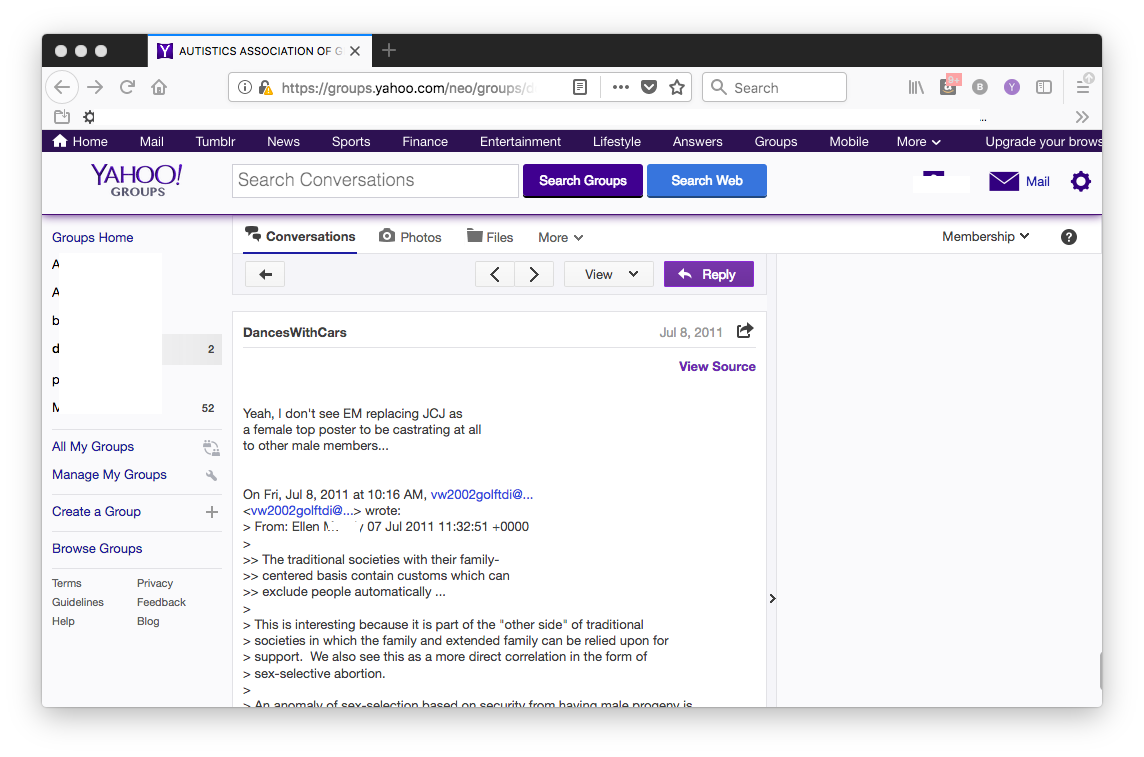
  Another post replying to the same list serve thread more seriously without a specific connection to how to do the most good for the most autistics most quickly is here in this image.


 That unilateral exercise of power led to the previous (and second in AAGW corporate history) librarian (Dances with Cars aka Jerry) leaving the group.  


   The initial librarian dropped out because her workload in library science graduate school prevented coming to one meeting per month (then on Sunday afternoons) not Saturday nights unless the 2 hour total of individual AAGW attendee food purchases already regularly force Teaism's owner to deny 'free' 4th Saturday of a month meeting space (in March, November and December) that is actually a 'community friendly' marketing gesture.  Jon G. is not the first person to have 'raised their voice' that triggered Mark B. fears and August 2018 abuse of power by turning a personal dispute into an organizational structure change (board of trustee expulsion with vote-rigging by resignation threat and later reduction in size of the board of trustees).   Officers devote their time but do not receive a vote at meetings of the AAGW board of officers and trustees.   AAGW is now an incorporated 501c(3) non-profit, despite as an IRS 1023EZ form applicant that has an unfortunate history of discouraging foundations from approving grants.   Perhaps more democratic (small 'd') AAGW governance procedures of an equal vote at quarterly meetings for trustees and officers may entice foundations that are concerned with transparency and open governance back to consideration of funding grant proposals to supplement small individual donations if they are received in addition to the President and Chairman of the Board of Trustees paying for domain name registration and web site hosting services provided by a woman and autistic-operated business.   The trustees and officers devote similar amounts of time and individual money for operating the library, planning and leading a dinner and two other trips per year to trustees.  


Update Jan 13, 2019 following Jan 12, 2019 board meeting

The August 11, 2018 meeting minutes were approved by a vote of only the three trustees, Randy F., Charles C. and of course Mark B.  A procedural, or parliamentary, trick allowing Mark B. to "CYA" (cover your ass) from an appearance of unethical conduct and corruption, was to omit Mark's threat to resign from the minutes if Jon wasn't removed (Mark didn't get what he wanted).  Jon protested the omission of the vote-rigging threat fiercely but was silenced with another threat of expulsion based mostly on the style of Jon's communication rather than the substance.  Because the vote-rigging threat by Mark to resign if he didn't get his outcome wasn't actually said in the meeting (only made in the agenda before the meeting) the minutes didn't need to include the vote-rigging threat.  Here are the incomplete minutes 


that display the incomplete corporate recordkeeping of the Autistic Adults of Greater Washington if anyone at the Virginia State Corporation Commission
[update Dec 14, 2019 link may lead to a password protected site], or interested citizen, is interested in addressing impropriety and/or corruption in nonprofit corporate governance.   The AAGW corporate records online at the Virginia State Corporation Commission web site may have been password-protected.  Here is another link that shows the core AAGW corporate leadership without a username and password account with the Virginia State Corporation Commission.  The other two trustees live on Dean Mar Drive and Keating Street.


Mark B. and Chuck C. refused to discuss Jon's complaint further and avoided interaction with Jon except for public settings of Teaism restaurant general and board meetings.  This was an attempt to let enough time pass by that would 'grind down' Jon's justified reaction of being treated unfairly and force Jon to either accept the mistreatment or quit.  Jon does not accept arbitrary and capricious abuses of power and Chuck C. joined Mark B.'s practice of simply walking away when they became tired of what they misperceived as Jon's 'belligerence' or 'venting.'  Avoiding interacting with Jon except in public settings helped in suppressing escalation after walking away and ignoring Jon who wished to avoid more 'drama' or 'scenes' in public that can easily be misconstrued as a threat requiring police involvement.  Mark B. exercised his unilateral authority, after likely consultation with Chuck C. after a July 17, 2019 handover of the empty library bag for repairs, to remove Jon from the yahoo group and ban Jon from any meetings or activities.  A threat to complain to Google, the owner of the blogspot platform, for sharing the AAGW leadership problems with a wider audience, because of sharing emails and board meeting minutes, was made.  In Mark B. haste to expel and ban Jon before another required board meeting (one every 3 months that must be held by Sept 30, 2019) he forgot to arrange a handover of the library collection by the July 27, 2019 general meeting.  The members who continue to bother to show up in person for 'dinner and a support group meeting' continue to be deprived of the library collection. Most of the books were originally donated by Chuck C. who walked out on Jon when picking up the empty bag for repair.  No attempt has been made to arrange a return of the library books.  

  Maybe instead of complaining to Google about disclosing confidential information (to suppress negative search results in name searches) Mark B. could designate someone else to ask Jon to return to AAGW library books.  The substance of Jon's communication was more important than the 'raised voice' style that only indicated intensity of demands after 'inside voice' tone failed to achieve mutually beneficial results.  Autistic Self Advocacy Network ASAN is generally against ABA (applied behavior analysis) as a way to help autistics 'fit in' with neurotypical society because it forces autistics to communicate in a manner contrary to individual neurodiversity. One contributor to "Loud Hands" a book compiled by and published by ASAN even demanded assault prosecution for ABA therapists who stop autistics from making repeated hand movements known to autistics as 'stimming.'


 ASAN generally demands that individual communication styles should be respected even if the autistic is able to use speech instead of assisted and augmentative communication technology AAC. The general demand for acceptance of neurodiverse communication styles is made here in the Loud Hands anthology. 


  Mark B. and Chuck C. as 'autistic leaders' failed to respect Jon's diverse style of communication as ASAN demands.  Your humble blogger, Rustedaspie, recommends that ASAN should refuse to work with AAGW leaders, who failed miserably to 'practice what they preach' regarding democratic leadership practices and respecting communication style diversity in dispute resolution, in planning any future National Summits of Autistic Led Organizations following up on one held on Nov 20-21, 2016 following an ASAN fundraising dinner. 

To paraphrase the post below


https://www.instagram.com/p/B0bSpWdBk8L/  

don't be afraid to speak truth to power even if it costs a 14 year relationship and 8 years of substantive volunteer library management.

Wednesday, June 27, 2018

Reflections on Democratic county executive nominee Marc Elrich and likely successor to Isiah Leggett


   Update July 14, 2018 to include histories of Virginia car tax as a proxy for a local income tax.  More material also added about political populism (good government process) distracting from economic populist fiscal and budget policy of how income and property taxation are spent.


   Well, voters for Marc Elrich ‘won the most numbers’ (of votes) in the Montgomery County, MD Democratic primary for county executive. His voter base carried Marc Elrich to victory in the Democratic primary based on wanting to make the county executive, council and planning board more responsive to citizens not new home builders demonized as ‘developers.'  No, candidates like Marc Elrich are actually more accountable to citizens/civic associations.    


   Individual members of citizens/civic associations constantly deflect their own progressive exceptionalism (lack of economic populism) of maximizing personal aging in place/active adult home sale resale (or rental while waiting for a higher offer) profit, passed down to survivors after dying in place, by projecting their greed onto new housing builders ('developers') with the political populism of campaign finance reform.  Those citizens/civic associations (with a civic federation umbrella group) are 100% homeowner in membership earning high enough incomes to have much discretionary ‘time on their hands’ to build relationships with council and planning board members and staff as well as show up at hearings.  

   No, voters didn’t elect ‘more responsive’ government officials.  All voters did was make #MoCo less welcoming to anybody who earns less than the projected median income of about $145,000 per year by 2030 which would be the end of a hypothetical third term for Marc Elrich and any other council members elected in 2018.

   Note those 2017 signs residents put up when they were resisting ‘President’ Don Trump’s 2017 and 2018 increased deportations and Muslim (entry) travel bans in multiple languages that said

“No matter where you’re from, we’re glad you’re our neighbor,” well, those signs are half right.  “We don’t care where you’re from, we don’t care what you look like, all we care about is what your financial assets and income look like on a mortgage or rental application,” is what the signs should say.


   Again, addressing voters for any candidate other than George Leventhal or Rose Krasnow in the 2018 #MoCo Democratic primary, anyone who doesn’t expect to be earning $145,000 per year by 2028 or 2030 start house hunting or apartment hunting in other counties than MoCo if you want to stay in MD.  Or DC or right-to-work-for-less VA.  That hostile worker climate to create a ‘good business climate’ is why the wages are lower that correspondingly lowers the housing costs.  That local income tax voters pay in MD is replaced in VA by the same bill on the first $20,000 of car value as personal property tax.  So the tax costs of Md and Va. are kind of a ‘wash’ if one does move to VA.  The rate varies by county, like Maryland local income and property taxes, with a state offset that varies too that avoids recurring 'structural' state (commonwealth) of Virginia budget deficits.

       Political populism by rich 1%-er upwardly mobile professional/creative class (actually or aspirationally, by professional clothing, vocabulary and lifestyle choices) destroys economic populism that helps 99% (in actual wealth or lack thereof AKA working class and working poor) retain decent pay and living standard (including affordable, to even earners of 30% of area median incomes, housing distributed to all master plan areas) with an equitable share of productivity gains
 
paid, as net gains, to labor more than capital.


   Trust in executive and legislative branch fiscal policy decisions, on school and other public services, in Prince George’s county by supporters of 1978 TRIM (Tax Reform Initiative by Marylanders)


   10.    Under a new computation model that assesses value at 100 percent rather than at 40 percent, the tax cap became 96 cents per $100 of assessed value in 2001. It has stood, unchanged, ever since.
      
The current debate over TRIM mirrors those of the past. It’s a conversation about government spending, mistrust and keeping up with the neighbors, such as Montgomery and Fairfax counties. In an interview, former delegate [David] Bird, who now lives in Howard County, said he was chagrined to see Prince George’s cap in danger again: “It remains one of the few checks the public has on government. It would be a shame if you don’t let voters decide.” But to [Parris] Glendening and other elected officials [successor executives Jack Johnson and Rushern Baker] trying to balance Prince George’s annual budget, TRIM is one of many reasons the county struggled to make progress improving schools and attracting sought-after businesses.


and 1996 Truth In Taxation

Del. Joanne C. Benson (D-Dist. 24) of Landover was there in 1978 when a group of residents banded together at a meeting to pass TRIM.
"Research showed us that if we put this initiative in place, in 25 years we were going to see a devastating impact on public education and public safety, and that is exactly what has happened," Benson said.
She said those issues were set aside by longtime residents looking to curb funding for an influx of African-American students enrolling in county schools.
"That initiative was designed to slow down the amount of money allocated to educating children in a certain population," she said. "I was adamantly opposed."
The referendum passed, but came under attack in 1996 in a drive led by then-County Executive Wayne K. Curry (D). On Election Day, 80 percent of voters decided to leave TRIM in place.
Looking back, school board Vice Chairman Howard W. Stone Jr., who worked on the 1996 referendum for Curry, said it came down to trust.
"People have a problem with just giving government a blank check," Stone said.
With such a resounding majority unwilling to repeal the tax cap, some are considering modifying the law instead of repealing it by referendum.
"[TRIM] needs to be repealed," Stone said. "But modifying the tax cap might get more citizen support. I think people would be willing to support modifying TRIM if we earmarked the money specifically for education and public safety."
Prince George's County is not the only jurisdiction with property tax caps. California instituted caps around the same time as Prince George's, said Marie Howland, a professor of urban planning at University of Maryland, College Park, who has studied taxes for decades.
"California has had the same problems with their schools since they passed a real strict tax cap in the '70s," Howland said. "The problem with things like TRIM is that the quality of schools go down, which means the quality of the work force goes down, and the region becomes less competitive. ... It seems like a good idea in the short term, but in the long range, communities suffer.
"It's one of the reasons Prince George's is not as competitive as Howard County and Montgomery County," she said.


and Prince George's County Republican Party Central Committee litigants in 2017


Fred Price Jr. and James K. Wass believe the 4 cent increase in the county’s real estate tax rate approved in 2015 violated the county charter’s Tax Reform Initiative by Marylanders, or TRIM, because it happened without voter approval. Price had filed the lawsuit against Prince George’s County with fellow Republican Party Central Committee member Wass.

The lawsuit appeals to have the 2015 tax increase placed on the 2018 ballot as a referendum.

“And, hopefully, reversed,” Price said. “It ought to be rolled back and properly put before the voters.”
Although the suit was initially filed in September 2016, it was amended earlier this year and rulings on various motions have occurred in recent weeks.


“Because the court has rejected all of the motions to dismiss filed by the county, that tells me that we have a legitimate case on hand,” said Tamara Davis Brown of Prince George’s Tax Watch.


are the Prince George’s county local manifestation of Montgomery County’s Republican Robin Ficker-inspired CPI cap on property tax increases with regressively harder votes (7 of 9 until 2008 unanimous 9 member council vote) met in 2016 responded to with term limits to enforce an effective property tax rate and revenue cap.  The all-district council Montgomery County, Md ballot initiative Question C of 2004 served as another 'moderate' Republican (or 'politically independent' 'bipartisan' 'compromise') disruption of economic populism with political populism. 


   Thanks again Montgomery County, MD Democratic primary voters for making the county welcoming in all ways but economic class. Well not entirely.  We’ll have our ‘token’ low income population - whoever can wait 5-10 years for whatever HUD and HOC rent vouchers we’re willing to fund (and apartment landlords are willing to accept) to spend property and income taxes on as long as people can wait 5-10 years on the waiting list continuing to pay ‘free market’ housing costs. The housing ‘free market’ is rigged by variations on the same ‘as few new residents as possible while plausibly denying the nimby position’ expressed in terms like this


"other county needs, including the adequacy of schools, roads, transportation and green space, as well as environmental stewardship, safety, and care for our seniors,"

 theme at every Planning Board and County Council master, sector, project plan and subdivision staging (formerly known as growth) policy hearing since, and probably before, 2002.

Friday, June 8, 2018

Copiosis or No Physical Object Money/Net Benefitism same failed Reagan and Kemp Republican trickle-down/voodoo economics


  Copiosis may not be a scam, as its founder Perry Gruber denied here.

    Copiosis is, however, a rebranding of nopom.info or nopomstuff.info.  The latter 2 web sites promote the same new economic system based on the book by Larry K. Mason called "Invisible Hand."  


  In 2009 Democratic celebrations of the inauguration of President Barack Obama were interrupted by the 700,000 job losses per month result of the Sept 15, 2008 'wall street' secondary mortgage market and later sovereign wealth fund crashes requiring $800 billion in federal stimulus (American Renewal and Recovery Act ARRA recovery.gov) spending.  Austerity budgets to pay back private lenders to the EU central bank were most acute in Portugal, Ireland, Greece and Spain. USA-based Republican politicians returned to their role in the legislative minority (continuing to seek 'a way forward' in the next election cycle) as annual deficit and multiyear debt hawks supported by 'taxed enough already' TEA party rallies (later rebranded House Freedom caucus after the 2010 elections and 2011 state reapportionments following the decennial census).  Some of those reapportionments have been changed by court findings of illegal partisan gerrymandering.  Perry Gruber and Larry K Mason posted letters here promoting what seemed like a nonpartisan, centrist, alternative economic system.  


  As far back as 2006 Larry Mason's book "Invisible Hand" had been promoted here.  The second review, posted in 2006,


 By Lydia Glider-Shelley Dec 1, 2006
"Powerfully compelling. A must-read!" Last week I had the wistful experience of finishing one of the most thought-provoking pieces of literature I have ever had the pleasure of reading. Wistful because like any good book, you get to know the characters and are loath to bid them adieu. One can only hope this phenomenal writer will see fit to pen a sequel or perhaps some related short stories. On a par with Ayn Rand's monumental "Atlas Shrugged" without the long repetitive central speech that Ms. Rand felt it necessary to include in her work, "Invisible Hand" by Larry Mason suggests a viable solution to the problems plaguing America. Poverty, crime, drug addiction, health care, housing, nutrition... all of these are dealt with in a new type of society: one in which we are paid according to the net benefit of our actions. Basic food, clothing, shelter, medical care and certain other necessities such as education (at all levels) are "free" or no charge to people in this scenario... although there are still luxuries and private ownership available to those willing to work and earn them. Private ownership is changed, however as there is no longer joint ownership of anything. This and many more intriguing concepts are explored in this brilliant masterpiece, which I highly recommend. While you're at it, buy a few extra copies for your friends and family. Enjoy!


 compared "Invisible Hand" to Atlas Shrugged by Ayn Rand "without the long repetitive central speech[.]"


  A reviewer with a similar name posted the first of 2 reviews of "Invisible Hand" on Amazon in 2014. 


  Copiosis and nopomstuff.info (formerly nopom.info) are simply far- right economic views that overvalue individual freedom to make choices and delegitimize the role of a regulatory and administrative state to protect individuals from exactly the type of financial services industry fraud that only the state has the capacity to fix and prevent a recurrence.  The descriptions of copiosis and nopom.info (now nopomstuff.info) are simply earlier versions of gas-lighting and black knighting that only polarize political discourse further driving some people to avoid civic and political activism (including voting) entirely.  Some people alienated from electoral politics pursue other alternative systems and vote for third party candidates in both primary and general election cycles resulting in more far-right Republicans getting elected and reelected from 2010-2016.  The descriptions of @copiosis (twitter.com page) and nopomstuff.info in the comments comments here sound appealing by denying partisan motives and descriptions.  


   Demands for faster paces of change, to do more good for more people more quickly, to pass the laws and implement the regulations usually highlight the division such as whether to have free college or free public college tuition or whether to allow all individuals the choice to buy health insurance from Medicare or require all individuals to buy health insurance from Medicare with taxes replacing health insurance premiums.  Even the 2010 Dodd-Frank act that created the CFPB (Consumer Financial Protection Bureau) that has been gutted since the November 2017 change in director to Mick Mulvaney, in particular, was the subject of 'pace of change' arguments about how strongly to re-regulate banks.  Disputes of whether the Glass-Steagall act, repealed in 1999, should have been included continue to divide Democrats and suppress their base voter turnout.  Any new proposal that is marketed as 'nonpartisan' or 'neither left nor right' becomes attractive as people seek a 'new normal' amidst chaos on many issues while trying to 'keep a roof over individual heads' by 'paying bills' from 'any job' one can 'get hired for' and keep including multiple jobbettes or the 'sharing economy.'   


   Exaggerated individual freedom, disputed here, while limiting the role of government in the economy demonstrate another book based on "Atlas Shrugged" is more accurate based on the results of how most people experience, despite personal denials of harm and claims of personal resiliency in crises, the effects of the political and economic systems on their daily lives. 

Monday, June 4, 2018

Bipartisan proposal to improve public sector help with inclusion and social acceptance in nondisabled (temporarily able-bodied) society


  Republicans presume high self-motivation in all people with disabilities.  If a person with a disability is not self-motivated it’s an individual problem that Republican politicians don’t want to help pay to fix.  Republican-passed state, local and federal budgets don’t appropriate and authorize enough money to fund (examples from last 25 years)
  block grants,
vouchers,

 premium support (2018 outgoing Budget Committee chairman and House Speaker Paul Ryan medicare privatization attempt of 2011-2013),

‘money follows person’ meme to spend medicaid LTSS money in HCBS settings to end the ‘institutional bias’ to funding nursing homes (RTC)

and

'Ticket to Work' individual funding to 'Employment Networks' as job development funding for people with disabilities.


   The inadequate appropriated and authorized funding levels, in omnibus year-end funding bills to avoid government shutdowns (except Oct 2013 and Jan 2018) only give ongoing funding inadequately adjusted for inflation because of how inflation rates are calculated. 

  Democratic elected officials (demonized and delegitimized as ‘politicians’) are more willing to help pay to fix Independent Living problems people with disabilities live with and attempt to solve at savagely unequal rates of good life outcomes.  The ‘big data’ sampling and ‘number crunching’ to attack the basis for my conclusion of inequality starting when people are left ’on their own’ without government assistance is a change of subject.  Stick to the ‘big picture’ I am ‘using my words’ to ‘draw.’ 


  But Democratic budget appropriations and authorizations have regulations that, when enforced, can tend to be judgmental or paternalistic and don’t respect high self-motivation if the person with a disability has it.  Lack of respect for individual self-motivation results from a bureaucratic imperative to prevent ‘waste, fraud and abuse’ that fills IE group and campaign committee negative 'election season' ads, to replace the executive and legislative branch elected officials who appoint and confirm the supervisors of the civil servants, each election cycle.  Those confirmed supervisors hire the 'nonpolitical' civil service/public/government employees.  


  The ads can be posted online and shared between social media accounts to shift distribution costs from tv and radio purchases to paying 'digital' or 'social' media staff to purchase displays of ads from social media platform owners.  The social media platform owners and the campaign committee staff then identify real peoples’ social media accounts and target them with the algorithm-based ad purchases on social media web sites the targeted individuals receive free hosting from.  Individuals use social media to share parts of their lives more easily than remembering to email ‘everyone they know’ about ‘how they are doing’ at one ‘point in time’ usually the year-end holiday season.

  Republican politicians try to use low self-motivation as a reason to spend less tax dollars to help and blame individuals for their own problems if low self-motivation is an issue ‘holding someone back.” Combine Democratic Party adequate funding levels with Republican Party higher regard for individual initiative. 

ABLE Act of 2014 a bad precedent to follow as Social Security trust funds spend down


  Both parts of section 4 of the ABLE Act of 2014 are classist by favoring people who have more economic wealth at the time an ABLE Account is started and funded as well as ongoing continued private deposits made by relatives and friends of the beneficiary with a disability.


  Section 4 part a of both S. 313 and HR 647,

 SEC. 4. TREATMENT OF ABLE ACCOUNTS UNDER CERTAIN FEDERAL PROGRAMS.

    (a) Account Funds Disregarded for Purposes of Certain Other Means-
Tested Federal Programs.--Notwithstanding any other provision of
Federal law that requires consideration of 1 or more financial
circumstances of an individual, for the purpose of determining
eligibility to receive, or the amount of, any assistance or benefit
authorized by such provision to be provided to or for the benefit of
such individual, any amount (including earnings thereon) in any ABLE
account (as defined in section 529(f) of the Internal Revenue Code of
1986) of such individual, and any distribution for qualified disability
expenses (as defined in paragraph (3) of such section) shall be
disregarded for such purpose with respect to any period during which
such individual maintains, makes contributions to, or receives
distributions from such ABLE account, except that, in the case of the
supplemental security income program under title XVI of the Social
Security Act, a distribution for housing expenses (as defined in
subparagraph (B)(ii) of such paragraph) shall not be so disregarded,
and in the case of such program, only the 1st $100,000 of the amount
(including such earnings) in such ABLE account shall be so disregarded.

 regarding the $100,000 exclusion for housing expenses is unrealistically low regarding cost of buying housing for person with a disability but realistic as an annual distribution to a checking account for monthly rent payments, for living alone without roommates, in a community setting in most cities and suburbs with adequate service provider communities (or enough other people with disabilities to operate consumer-survivor/peer support/self-advocacy organizations.  With varying degrees of effectiveness, peer support/consumer-survivor/self-advocacy organizations ’fill in gaps' in public/private (bid-down-payroll ‘bdp’) services.  Privatization of public services is mostly about using the competitive bidding process to lower payroll to people actually doing the work in benefit costs and/or pay for their time in salary or wages.  That is why I refer to privately delivered, publicly contracted public services as ‘bid down payroll’ or ‘bdp.’ 


  Section 4 part b


SEC. 4. TREATMENT OF ABLE ACCOUNTS UNDER CERTAIN FEDERAL PROGRAMS.

(b) Suspension of SSI Benefits During Periods of Excessive Account
Funds.--
            (1) In general.--The benefits of an individual under the
        supplemental security income program under title XVI of the
        Social Security Act shall not be terminated, but shall be
        suspended, by reason of excess resources of the individual
        attributable to an amount in the ABLE account (as defined in
        section 529(f) of the Internal Revenue Code of 1986) of the
        individual not disregarded under subsection (a) of this
        section.
            (2) No impact on medicaid eligibility.--An individual who
        would be receiving payment of such supplemental security income
        benefits but for the application of the previous sentence shall
        be treated for purposes of title XIX of the Social Security Act
        as if the individual continued to be receiving payment of such
        benefits.


of both S.313 and HR 647, regarding suspending SSI payments, if ABLE Accounts have an excess over SSI asset limits is, in practical effect, a privatization of SSI to those individuals with a disability who are from upper income class top 1% income levels. At the very least ABLE Act is a privatization (or wealth-enabled opt-out) of SSI to individuals with a disability for people who identify economically as above working class such as upper middle class or middle class.   Money deposited into accounts is discretionary income for sole purposes of income support for relatives who are a person with a disability.  People funding the ABLE Accounts earning minimum wage or 200% of minimum wage (higher if Cost of Living in primary residence area is higher than national average COL) will not be ABLE to afford as much in contributions. 


  Because not all families and friends of every SSI beneficiary are equally able to contribute to accounts that provide a more decent living standard the ABLE Act represents neoliberal, incremental social security system privatization in the same way 75 year advance pension funding in USPS Postal Reform act of 2006 was used to incrementally delegitimize defined benefit pensions in favor of defined contribution retirement accounts.  The ABLE Act as a new way to help people ‘graded’ as the most vulnerable, as a manifestation of an ‘oppression Olympics/severity contest’ to justify inadequate levels of spending in the appropriation and authorization budget process, people with intellectual disabilities.  People with behavioral (mental illness) or developmental disabilities without intellectual disability are left out in the population served by the ABLE Act unless they can qualify for SSI.    Gradually lower incomes over time resulting from the share of income to the richest rising (productivity gains less equally shared between workers and owners) lowers the amount of total income at an individual level and corresponding ability to contribute to ABLE Account.  The social problem of income support is treated as an individual problem to reduce at least short term social costs as stated in the interview granted by Helaine Olen to promote her book Pound Foolish.  


   A better public policy choice is to ‘#scrapthecap' as Social Security Works is part of a coalition demanding to strengthen social security, medicare and medicaid.  As a real compromise between progressives and neoliberals and neoconfederate ‘taxed enough already’/‘freedom caucus’ Republicans incrementally raise the cap on income subject to FICA taxes by the 2011 term 'grand bargain,' or chained CPI, instead of raising the monthly benefit amount by a lower amount annually.  Use the 'chained CPI' inflation rate to restrain the FICA income tax cap rate of increase on taxpayers not to restrain the growth of spending on Social Security Act beneficiaries who need the income they cannot earn by other means, demonstrated by SSI means testing and SSDI disability qualifications as well as people being entitled to receive benefits after paying into system while working, to an adequate extent to pay their bills.